Understanding Analog-to-Digital Conversion (ADC)
Whenever you record audio, make a phone call, or listen to streamed music, your device converts physical sound into digital data. This transformation is performed through Analog-to-Digital Conversion (ADC), a core process that enables modern audio systems to function.
Sound as it exists in the real world is analog. It is continuous in nature and produced by physical vibrations traveling through air. Digital systems, however, can only process information in discrete numerical form. ADC acts as the bridge between these two domains by translating continuous signals into a format that computers can store and manipulate.
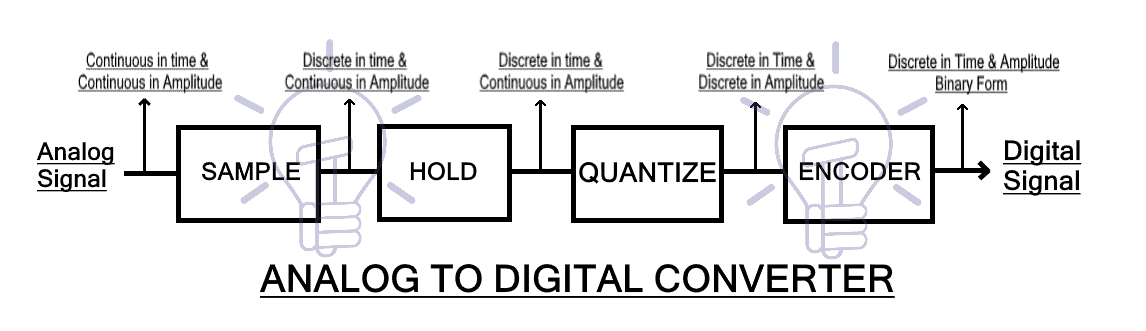
Block-level view of the analog-to-digital conversion process
The conversion process begins with a microphone. A microphone functions as a transducer, converting incoming sound waves into an electrical signal using a vibrating diaphragm. Although this electrical output is still analog, it can now be processed by an analog-to-digital converter.
The first major stage of ADC is sampling. During sampling, the converter measures the amplitude of the analog signal at uniform time intervals. The frequency at which these measurements are taken is known as the sample rate.
For instance, standard CD-quality audio uses a sample rate of 44.1 kHz, meaning the signal is sampled 44,100 times per second. Higher sample rates provide finer time resolution but require more storage and processing resources.
After sampling, the signal undergoes quantization. Each sampled amplitude is mapped to the nearest value within a finite set of representable levels. The number of available levels is determined by the bit depth.
Increasing the bit depth allows amplitude to be represented with greater precision, which reduces quantization error and improves dynamic range. This explains why low-bit-depth audio exhibits noticeable noise, while higher bit depths such as 16-bit or 24-bit produce cleaner results.
Together, sample rate and bit depth define the accuracy of a digital audio signal. Sample rate controls how precisely changes over time are captured, while bit depth controls how precisely signal amplitude is represented.
Once conversion is complete, the audio signal exists as a sequence of binary values.
This digital data can be stored in formats such as .wav or .aiff,
duplicated without degradation, and further processed or transmitted
with no loss in quality.
Key Takeaways:
- Sound originates as a continuous analog signal.
- Microphones convert sound into analog electrical signals.
- Sampling captures signal values at fixed time intervals.
- Quantization converts sampled values into discrete digital levels.
- Sample rate and bit depth directly influence audio fidelity.
Analog-to-digital conversion is fundamental to modern audio systems. Without it, technologies such as digital music production, audio streaming platforms, and voice-driven applications would not be possible.
Next coming with Analog Signal Mathematics and deep dive into Sampling, Quantization and bit resolution